Excitons and Phonons in Strongly Correlated MaterialsIn progress
An exciton — a bound electron-hole pair — does not live in a rigid lattice. The lattice distorts around it, and that screening changes how tightly it is bound. When the electronic correlations are strong, the perturbative treatments usually applied to this coupling stop being reliable. I study these systems with tensor networks, which keep the many-body state itself accessible where diagrammatic expansions break down.
The models are of Hubbard-Holstein type: carriers hopping on a chain, coupled both to each other and to local lattice vibrations. The Hilbert space grows exponentially with system size, but ground states of gapped local Hamiltonians obey an entanglement area law and are well represented as matrix product states, so DMRG reaches the sizes needed for a controlled extrapolation.
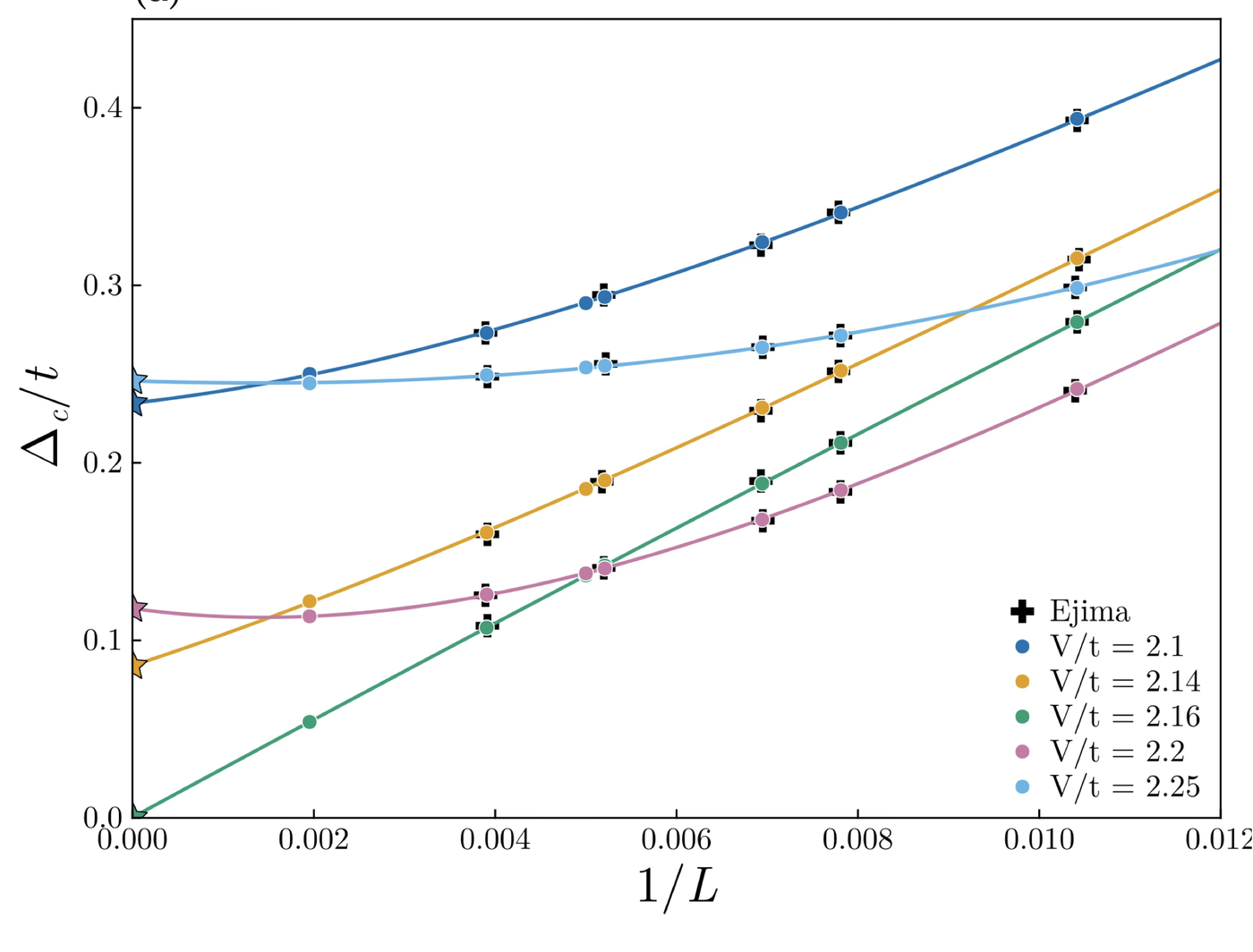
Before any new physics, the machinery has to reproduce what is already known. The figure shows the charge gap of the extended Hubbard chain extrapolated to the thermodynamic limit across the transition region, checked against published reference data.